诊所咨询费

第一次咨询(30分钟内)

$245 及以上

首次咨询时间较长(30 - 60 分钟内)

$345.00 及以上

后续咨询(30分钟内)

$165.00 及以上

长期跟踪咨询(30-60 分钟内)

$245.00 及以上

紧急咨询(30分钟内)

$385.00 及以上

紧急长时间会诊(W/IN 30-60 分钟)

$550.00 及以上

伤口敷料专业费用(不含消耗品)

$132.00 - 228.00(取决于复杂性)

额外的基于临床的双工超声评估

$150.00 - $320.00(取决于复杂性)

专科医疗报告

$200.00 - $ $330.00(取决于复杂性)

激光治疗费用

Vbeam 激光(每次限 30 次)

$650 及以上

Vbeam 激光(5 件套 + 1 件)

$3,250 及以上

Gmax 激光(每个患处/疗程)

$650 及以上

Gmax 激光(5 件套 + 1 件)

$3,250 及以上

Q 开关激光(每个患处/疗程)

$650 及以上

Q 开关激光器(5 + 1 套)

$3,250 及以上

诊所外问诊费用

医院住院诊疗(病房)

$380.00 及以上

医院住院诊疗(ICU)

$550.00 及以上

紧急咨询费

门诊时间内的急诊科

$380.00 及以上

急诊科门诊时间以外但午夜 12 点之前

$480.00 及以上

午夜 12 点后急诊室

$550.00 及以上

A&E 周末及公共假日

$550.00 及以上

* 所有价格以新加坡货币计算,不含商品及服务税,截至 2025 年 1 月 1 日为止准确无误。价格可能会相应变化。

预约

请填写您的个人详细信息,我们将就您的预约与您联系。

预约

填写您的个人详细信息,我们将就您的预约与您联系。
|Transarterial Microembolisation (TAME) for Osteoarthritis-Related Pain

Transarterial Microembolisation (TAME) for Osteoarthritis-Related Pain

Transarterial Microembolisation (TAME) is a minimally invasive endovascular procedure used to manage chronic pain associated with osteoarthritis and selected musculoskeletal conditions. When applied to the knee, it is known as Genicular Artery Embolisation (GAE).

In Singapore, TAME and GAE may be considered for selected patients who continue to experience knee and musculoskeletal pain despite conservative treatment and are exploring alternatives to knee replacement surgery.

What is Transarterial Microembolisation (TAME)?

Transarterial Microembolisation (TAME) is an image-guided endovascular technique designed to address the vascular component of chronic musculoskeletal pain.
Rather than treating the joint surface or cartilage directly, TAME focuses on abnormal small blood vessels that develop in chronically inflamed tissues. In conditions such as osteoarthritis, these abnormal microvessels are associated with ongoing inflammation and pain signalling.

TAME involves the selective delivery of microscopic embolic particles into these vessels, reducing blood flow to inflamed tissue while preserving normal circulation to surrounding structures.

The procedure is performed through a small arterial access under imaging guidance and does not involve open surgery. As it targets inflammation rather than structural joint damage, TAME is used as a pain management strategy rather than a curative treatment for osteoarthritis.

Genicular Artery Embolisation (GAE) for Knee Osteoarthritis

When Transarterial Microembolisation is applied to the knee, the procedure is known as Genicular Artery Embolisation (GAE).

Knee osteoarthritis is commonly associated with chronic inflammation of the joint lining and surrounding soft tissues. This inflammation is often accompanied by the formation of abnormal genicular blood vessels, which contribute to pain and reduced function.

GAE targets these abnormal vessels supplying inflamed areas around the knee joint. Using angiographic imaging, the genicular arteries involved in the inflammatory process are carefully identified and selectively embolised. This helps reduce inflammation and pain while maintaining the main blood supply to the leg and knee.

GAE is currently the most established and studied application of TAME, with growing clinical evidence supporting its role in managing knee osteoarthritis pain in selected patients.

How TAME and GAE work to reduce pain

Knee angiogram showing abnormal neovascularity
Angiogram showing abnormal neovascularity at the infrapatellar fat pad.
Source: Endovascular Today (2018)

TAME and GAE reduce pain by targeting the underlying inflammatory and vascular processes, rather than the joint surfaces themselves.

In osteoarthritis and related conditions:

  • Chronic inflammation leads to the growth of abnormal microvessels
  • Pain-sensitive nerves run alongside these vessels
  • Persistent blood flow to the inflamed tissue sustains pain signals

By selectively embolising these abnormal vessels, TAME and GAE may:

  • Reduce blood flow to the inflamed tissue
  • Decrease inflammatory activity within the joint
  • Interrupt pain signalling pathways
  • Help improve pain levels and functional movement over time

Because the treatment is highly targeted, normal blood supply to the limb is preserved. Pain improvement may occur gradually over several weeks as inflammation settles.

Who may be suitable

Transarterial Microembolisation (TAME) and Genicular Artery Embolisation (GAE) may be considered for selected patients with chronic pain related to osteoarthritis, most commonly involving the knee.

These procedures are typically considered when symptoms persist despite appropriate conservative treatment.

TAME may be suitable if you have ongoing knee pain that affects daily activities and you are exploring a minimally invasive option to manage symptoms.

This approach may be considered if you:

  • Have persistent musculoskeletal or knee pain despite physiotherapy, medications or injections
  • Have mild to moderate osteoarthritis
  • Are not ready for joint replacement surgery, or are seeking joint replacement alternatives
  • Are not ideal candidates for major surgery due to age or medical conditions

A consultation is important to determine whether an endovascular approach is appropriate and to set realistic expectations.

TAME and GAE as alternatives to knee replacement surgery

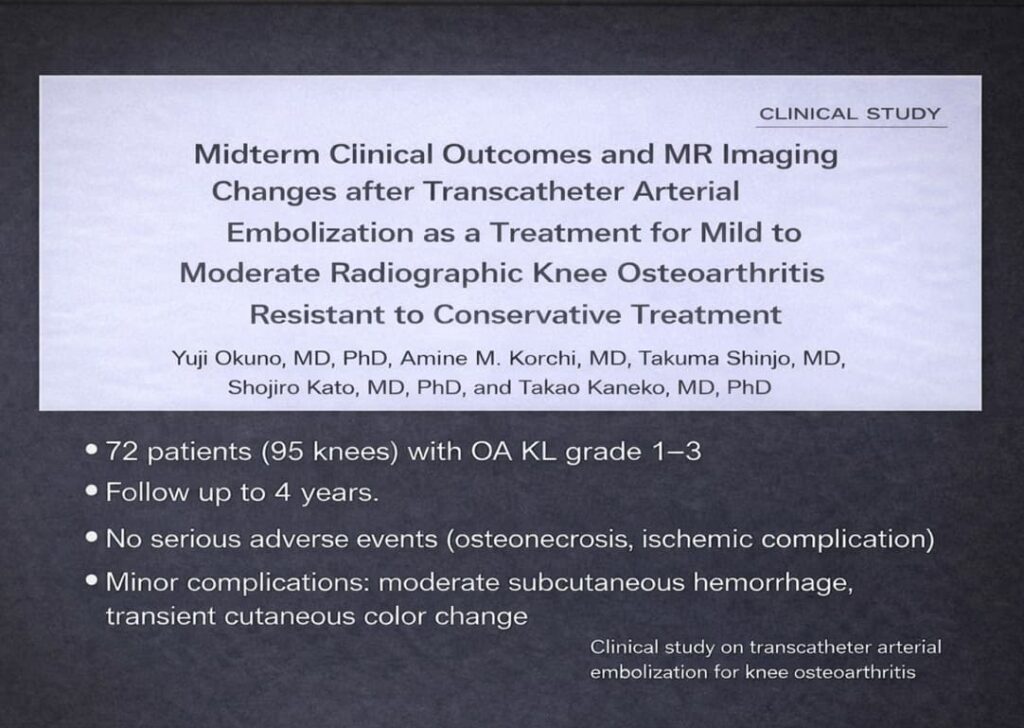
Clinical study of Transcatherer Arterial Embolisation for knee osteoarthritis

For advanced osteoarthritis, knee replacement surgery remains an established treatment that can improve pain and function for many patients.

However, some patients may not wish to proceed with joint replacement early and others may not be suitable candidates for major surgery.

In selected cases, TAME and GAE may be “alternatives” or interim treatments to knee replacement surgery, particularly when the goal is pain reduction and improved day-to-day function rather than correction of structural joint damage.

These procedures do not reverse cartilage loss and they are not intended to replace knee replacement surgery in severe, end-stage osteoarthritis.

TAME and GAE are commonly considered when:

    • Symptoms remain troublesome despite conservative care
    • Surgery is not preferred at this stage
    • Surgery carries a higher risk due to other medical conditions
      Outcomes vary between individuals, so a personalised discussion is essential.

What to expect during the procedure

TAME is a minimally invasive, image-guided procedure and is usually performed under local anaesthesia, without the need for open surgery.

A small arterial access is used, commonly at the groin or wrist, through which a catheter is guided under imaging to the target blood vessels. The procedure typically takes around one to two hours.

Most patients can mobilise shortly afterwards, and many cases are suitable for day surgery, allowing patients to return home the same day.

In most cases, patients can expect:

    • A small puncture site, with no large incision
    • Early mobilisation following the procedure
    • A short recovery period compared with surgical options

Aftercare and activity advice will be tailored to the individual.

Safety, evidence and limitations

Clinical studies suggest that TAME is generally well-tolerated when performed in appropriately selected patients. Many individuals experience improvements in pain and daily function, although the degree of improvement can vary.

It is important to understand that these procedures are not curative and do not halt the progression of osteoarthritis. Pain improvement may be gradual and can take several weeks as inflammation settles.

Possible limitations and side effects include:

  • Partial or variable pain relief
  • Bruising at the access site
  • Temporary skin changes or local discomfort
  • A small risk of complications, as with any endovascular procedure

Expected benefits, risks and alternative treatment options will be discussed before any procedure is recommended.

Patient information

Transarterial Microembolisation is usually performed under local anaesthesia. Most patients experience minimal discomfort during the procedure. Some mild soreness or aching may occur afterwards, but this is typically temporary.

Pain improvement is often gradual rather than immediate. Many patients notice improvement over several weeks as inflammation settles. The degree and timing of relief can vary between individuals.

The duration of symptom relief varies between patients. Some experience sustained improvement, while others may notice symptoms returning over time. This can depend on disease severity, activity level and progression of osteoarthritis.

Yes. In selected cases, Transarterial Microembolisation may be repeated if symptoms recur and reassessment shows that repeat treatment is appropriate. This is decided on an individual basis following clinical review and imaging.

Transarterial Microembolisation does not preclude future surgery, including knee replacement if it becomes necessary later. When the procedure is performed for knee osteoarthritis, this is referred to as Genicular Artery Embolisation.

Transarterial Microembolisation is primarily considered for osteoarthritis-related pain and selected musculoskeletal conditions where inflammation plays a significant role. It is not suitable for all causes of joint pain, and assessment is required.

The procedure targets abnormal microvessels associated with inflammation while preserving normal blood supply to the limb. Serious long-term complications are uncommon when the procedure is performed in appropriately selected patients.

Suitability is determined through a consultation with a vascular specialist, including clinical assessment and imaging. This helps ensure the treatment is appropriate and expectations are realistic.

我们的医生

资深血管及普通外科医生

MBChB、FRCS(玻璃)、FRCS(英语)、FRCS(Gen)、FAMS

资深血管及普通外科医生

文学硕士、医学学士(外科优异)、英国皇家外科学院格拉斯分校医学博士(剑桥)、英国皇家外科学院院士(普通外科医师学会会员)、美国外科学院院士(FAMS)、英国外科学院院士(CWSP)

资深血管及普通外科医生

MDCM(麦吉尔大学);美国外科委员会(普通外科、血管外科);FAMS;RPVI